Collections
A silicone reborn doll is cast in solid or partial silicone rather than vinyl — denser, squeezable and finished to a much higher paint grade. Here is how the two constructions differ, what realism actually costs, how long they last, and how to specify one from the factory.
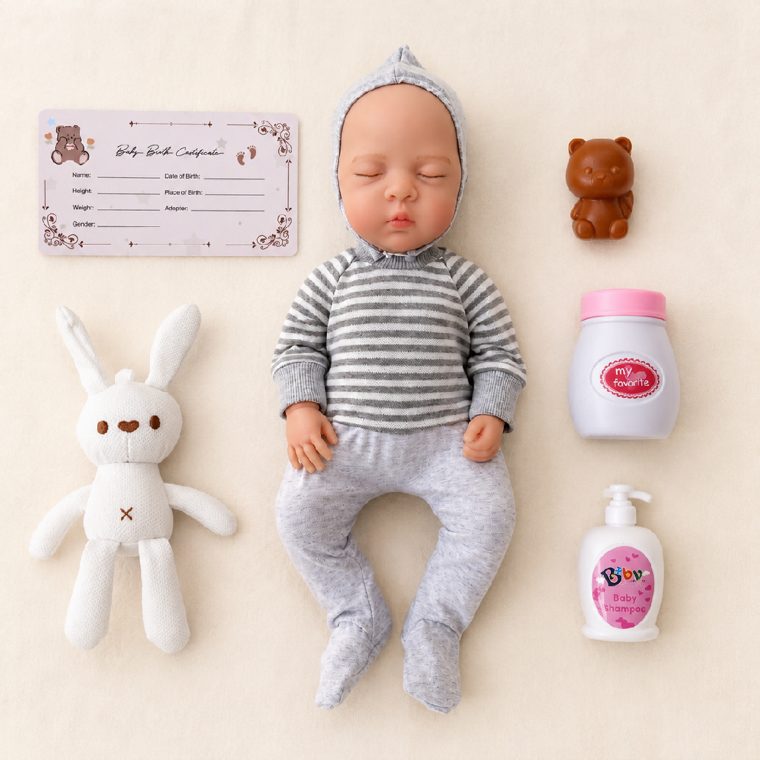
A silicone reborn doll is made by pouring platinum or tin cure silicone into a sculpted mould instead of using vinyl. The result is solid rather than hollow: press the arm and it gives slightly, the way skin does. Because the material itself carries the flesh tone, the paint sits on the surface as translucent layers rather than as a single coat, which is why silicone reads as more lifelike than vinyl does at the same distance.
We run around fifty solid-silicone styles across 16″ to 24″, with 18″ the most-produced size. Every one is hand-finished; none of it is outsourced.
Full body silicone is solid from head to toe — including the torso. It is the heaviest and most lifelike option: our 18″ full-body pieces weigh between 2,965 g and 3,630 g, which is roughly what a real newborn weighs. Everything squeezable is real.
Partial silicone pairs a silicone head and limbs with a soft cloth torso. It is lighter, easier to pose and noticeably cheaper to ship. Our 18″ cloth-body versions come in at 950–1,150 g — about a third of the weight. If the doll is meant to be carried by a child or an elderly resident rather than displayed under glass, partial is usually the better answer.
Realism is assembly, not material alone. At artist grade a silicone reborn gets up to a dozen thin paint layers — mottling, veining, blush on the knees and elbows — then hair rooted one strand at a time for a hairline that has no seam, then a weighted body tuned so it settles into your arm like an infant rather than flopping like a toy. Our realistic baby dolls page breaks down which of those cues matter most when you are judging a photo online.
Silicone is stable but not indestructible. Keep it out of direct sunlight (prolonged UV dulls the paint and can shift the tone), avoid solvents and alcohol wipes, and dress it in soft cotton because dark synthetic dyes transfer onto light skin. Sharp jewellery and pet claws are the usual cause of tears.
The good news is that small superficial tears can be repaired. Because we keep the tooling and the paint formulation in-house, a damaged piece can be refreshed rather than replaced — worth knowing before you write off a damaged doll. Both constructions are tested against ASTM F963 (US) and EN71 (EU) toy-safety requirements.
Price tracks two things: how much silicone is in the doll, and how many hours the finishing takes. Full body costs substantially more than partial, and artist-grade paint costs more than standard. Size amplifies both — a 24″ full-body piece uses far more material than a 16″ one.
Our reborn doll price guide sets out the bands by material and size. If the budget is the binding constraint rather than the realism, read the affordable options first — the entry tier is much better than it was five years ago.
Everything is open to specification: sculpt, cure type, paint grade, hair type and colour, eye colour, mouth treatment, weighting target and your own labelling and packaging. Confirmed samples are sealed and archived privately, so a sculpt developed for you stays yours and never appears in another customer’s catalogue.
Our silicone ranges have no minimum order quantity. EXW or FOB terms are available, with your forwarder welcome. Start a specification on the custom dolls page, or request pricing through OEM/ODM.
Keep reading
FAQ
A reborn doll cast in solid silicone instead of vinyl — denser, squeezable and finished with translucent paint layers that make it read as skin. Full body means the entire doll is silicone; partial pairs a silicone head and limbs with a cloth torso.
If the priority is realism and feel, yes: nothing else in the category gets close on either. If the doll will be carried, washed and handled daily, a cloth-body version is lighter, cheaper and less precious — and usually the better buy.
Indefinitely, if kept out of direct sunlight and cleaned with a damp cloth rather than solvents. Platinum-cure silicone is more stable over time than tin cure and holds its paint better, which is why we default to it for artist-grade and export work.
Superficial tears usually can. Because we keep the tooling and the paint formulation on site, damaged pieces can be repaired and repainted rather than replaced. Deep structural damage is rarely economical to fix.
We run silicone from 6″ miniatures to 24″ toddlers, with 18″ the volume size. An 18″ full-body piece weighs 2,965–3,630 g; the cloth-body version of the same sculpt is 950–1,150 g.
Yes — our silicone ranges have no minimum order quantity, with platinum or tin cure specified per market and your own labelling applied. Request pricing through our wholesale page; we will tell you when the cheaper material is the right call.
Next step
Tell us the size, the material and the price band you are working to. We will tell you what we would run — and what we would not.
 HAL-see-on