Collections
What a reborn artist actually does with their hours, why artist dolls cost what they cost, and where the boundary sits between one-off art and factory production — including the part most buyers get wrong about both.
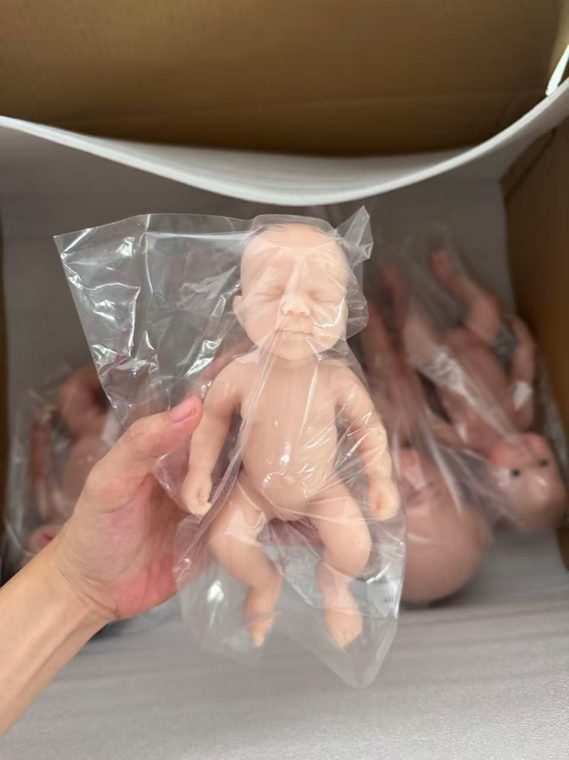
A reborn artist takes an unfinished sculpt — vinyl or silicone, straight from the mould — and transforms it into something that reads as alive. The work divides into four stations, and each is a separate skill: painting many translucent layers and heat-setting each one, rooting hair strand by strand, weighting the body to an infant’s centre of mass, and assembly and finishing — eyes, mouth, nails, clothing.
None of it can be meaningfully rushed. A single well-rooted head can take most of a working day on its own, which is where most of the price sits.
Some artists sculpt their own originals; more start from another sculptor’s work, which is legitimate when it is disclosed and licensed. Either way the first step after acquiring a kit is preparation: washing the parts to remove mould residue, sanding seam lines, and sometimes modifying — opening a mouth, adjusting eyelids, refining a nose.
Moulds themselves are the expensive part of the whole industry. A steel production mould represents thousands of dollars and months of work, which is why genuine custom sculpts cost so much and why factory lines reuse tooling across decades.
Painting is applied in thin layers, each heat-set before the next — mottling first, then veining, then blush on knees, elbows and ears, then a matte seal. Up to a dozen passes at artist grade, three or four at standard.
Rooting follows: several hairs per needle pass, following the hair growth direction, thinning at the temples. This is the step that most separates an artist doll from a mass-produced one, and it is almost impossible to fake convincingly — look closely at the hairline in any listing photograph. Our lifelike dolls page covers these techniques and their effect.
Expect a wait of weeks to months, a deposit up front, and progress photographs. Good artists will tell you what they cannot do — matching a specific photograph exactly, reproducing a copyrighted sculpt — rather than promising everything and disappointing later.
Be specific about what matters and honest about the budget. “The most realistic you can do” is not a brief; “newborn, 18″, rooted dark hair, olive skin tone, around X” is. See the custom dolls page for how we structure the same conversation.
Artist dolls are one-offs. Variation is the point — no two are identical, and the hours go into individual detail.
Factory production optimises for consistency across thousands. That is not a lesser ambition, it is a different one: a reorder three years later must match the original exactly, and every unit has to pass the same inspection.
The real difference is who owns the constraint. An artist answers to their own eye. A factory answers to your specification and a test report — and the second one is what you need for retail compliance, tender documents and institutional procurement.
If you are buying one extraordinary doll, commission an artist. If you need units that are identical, documented and repeatable, you need a factory — and asking an artist to scale up rarely ends well for either side.
We keep the same stations an artist uses, staffed by people who have done this for years, with the difference that every doll is measured against a sealed reference sample. Tooling stays on site, so reorders match. Start a specification on the custom reborn dolls, see the line on the factory page, or read the quality framework for how to judge either.
Keep reading
FAQ
They take an unfinished sculpt and transform it: many translucent paint layers each heat-set, hair rooted strand by strand, a weighted body tuned to an infant's centre of mass, then eyes, mouth, nails and clothing assembled by hand.
Several days to a few weeks of working time spread across the stations, depending on paint grade and whether hair is rooted. Rooting a single head can absorb most of a working day on its own.
Because they are hours, not units. The material is a small fraction of the price; the labour in layering paint, rooting hair and finishing detail is nearly all of it, and that work cannot be meaningfully accelerated.
Yes, either from an independent artist or from a manufacturer like us. Bring specifics — size, material, skin tone, hair type, whether it should match a reference — rather than 'as realistic as possible'. You will get a far better result and a far more accurate quote.
An artist doll is a one-off where variation is the point. A factory doll is built to be identical to every other unit in the run and repeatable years later, which requires tooling, sealed reference samples, documented inspection and safety testing.
Look for unretouched photographs across multiple dolls rather than one hero shot, clear disclosure of which sculpt was used, stated waiting times, and a written commission agreement. Reluctance to show work-in-progress is the clearest warning sign.
Next step
Tell us the size, the material and the price band you are working to. We will tell you what we would run — and what we would not.
 HAL-see-on