Collections
“Lifelike” describes a result, not a material. This is the craft side of the claim — what rooting, painting and weighting actually involve, why each step costs what it costs, and how they combine into a doll that reads as alive.
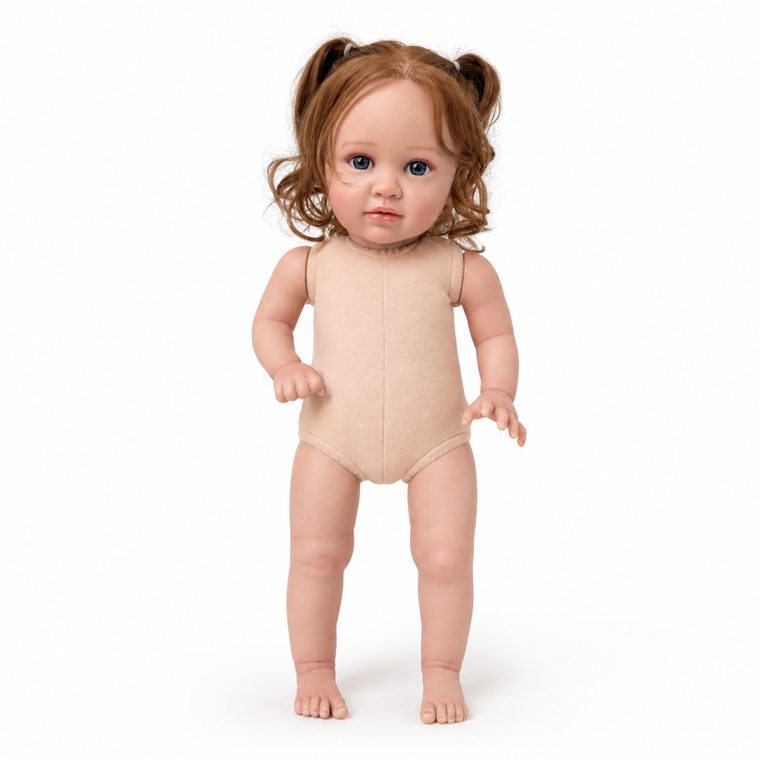
A lifelike baby doll convinces across three senses at once: sight, touch and weight. Get two and the third gives it away. A beautifully painted doll that weighs 700 g reads as a doll the moment you lift it; a perfectly weighted doll with flat paint fails from across the room.
So the honest way to judge “lifelike” is to ask where each of the three landed — not whether any single feature impressed you in a listing.
Rooted hair is inserted strand by strand with a fine needle, several hairs at a time. It takes hours per head and it is what produces a hairline with no edge — the detail that most separates a lifelike doll from an ordinary one. Mohair and fine synthetic fibre are both used.
Painted hair is quicker and cheaper, and honest artists do it rather than rooting badly. It suits newborn styles where hair is sparse or absent. Just do not pay rooted prices for it: check whether the listing says rooted or merely hand-painted.
Skin is built, not applied. Successive translucent layers go on and are heat-set, layering mottling, blush and veining under a final matte seal so depth appears to come from within the material rather than sitting on top of it. Up to a dozen passes is normal at artist grade; three or four at standard.
The tell for cheap work is a single opaque coat: it looks flat and slightly plastic in person, and it photographs better than it looks, which is exactly the problem when you are buying online.
Weight is distributed to reproduce an infant’s centre of mass — head weighted so it tips back into the crook of your arm, torso filled so it settles rather than flops. In our line that means:
| 18″ construction | Weight |
|---|---|
| Full vinyl | 760–1,150 g |
| Cloth body vinyl | 950–1,150 g |
| Solid silicone | 2,965–3,630 g |
All three are legitimate; they answer different buyers. Our own most-produced size is 18″ precisely because the newborn effect peaks there.
These get used interchangeably, and the confusion costs buyers money:
What you want to know is the outcome, so judge the result and ask which process produced it. See the baby dolls that look real page for judging outcomes specifically.
Start with use. Display case → prioritise paint grade and rooting. Carried by a child or resident → prioritise a lighter cloth body and washability. Gift → 18″, decide by whether the recipient collects or plays.
Then ask for two things every serious maker will give without hesitation: unretouched photographs and the measured weight. Everything else follows. If you want the full picture of the category first, read the reborn guide.
Keep reading
FAQ
The agreement between three things: layered translucent skin rather than one coat, a rooted hairline with no visible edge, and weighting distributed like an infant's so it settles into your arm. Two out of three is not enough — the missing one gives it away.
Hair inserted strand by strand with a fine needle rather than painted on. It takes hours per head and produces a hairline that thins naturally at the temples, which is what stops a doll reading as wigged.
Good ones are. Weight is distributed to reproduce an infant's centre of mass rather than simply added. At 18″ that ranges from 760–1,150 g for vinyl up to 2,965–3,630 g for solid silicone.
Reborn describes the making process — transforming a sculpt through painting, rooting and weighting. Lifelike describes how convincing the finished result is. The words are often used interchangeably, but they refer to different things.
Cost follows the hours and the material. Vinyl with painted hair is the entry point; full-body silicone with artist-grade paint and rooted hair sits at the top. The realistic baby dolls guide covers how to judge value at each level.
Usually 18″, since the effect peaks at newborn scale and standard baby clothing fits. Choose solid silicone for a collector and cloth-body vinyl for anyone who will actually handle it.
Next step
Tell us the size, the material and the price band you are working to. We will tell you what we would run — and what we would not.
 HAL-see-on